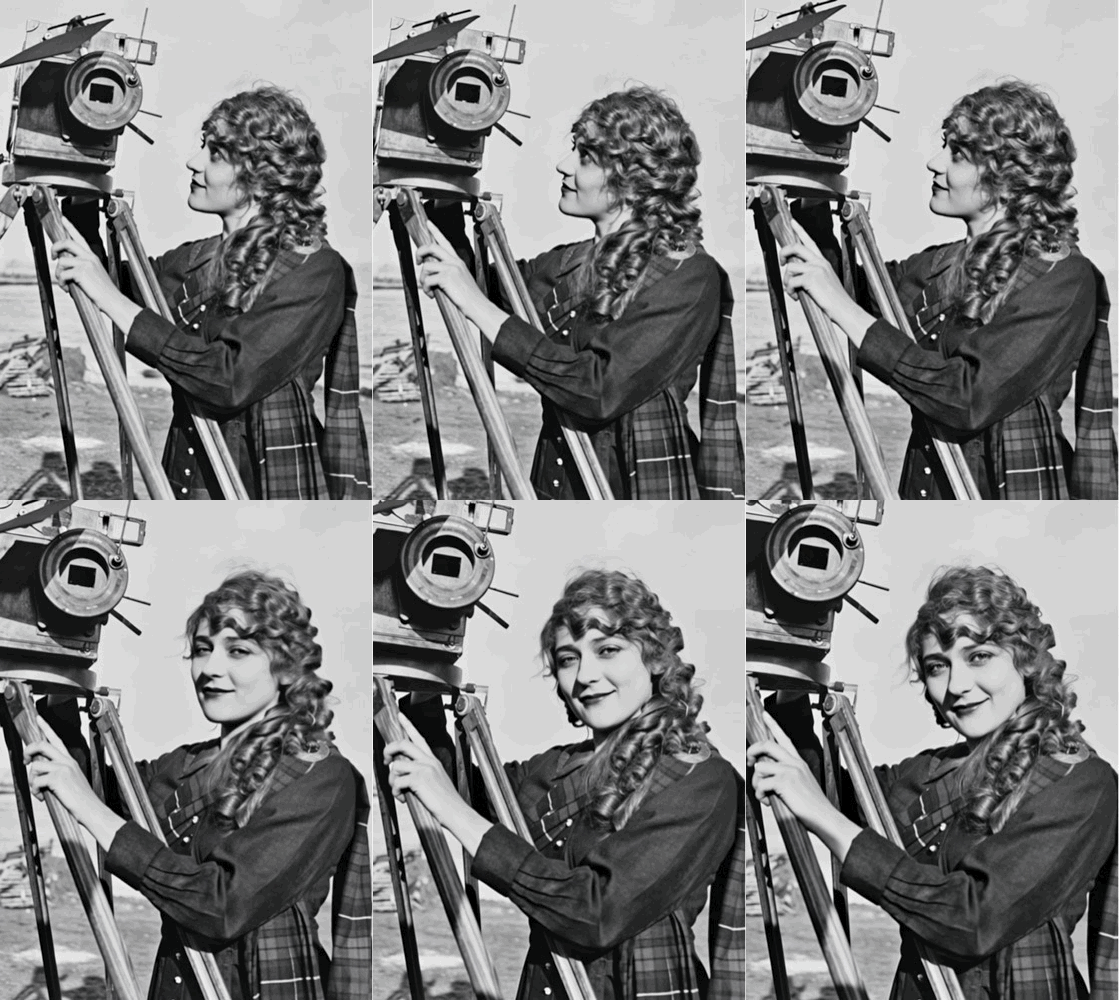
Mary Pickford
The woman from "the Ward" who invented the movie star
“You may have a fresh start any moment you choose, for this thing that we call "failure" is not the falling down, but the staying down.”
At the corner of Elm Street and University Avenue in Toronto, a modest bust of Mary Pickford commemorates her birthplace. The monument is too hidden, too battered, and far too small to properly honour the life of this giant of North American cinema.
Three thousand miles away on Hollywood Boulevard in Los Angeles, her handprints are immortalized in the sidewalk outside Grauman’s Chinese Theatre. Mary Pickford invented the tradition of movie stars pressing their hands and feet into wet cement.
Mary Pickford invented the movie star.
Heck, Mary Pickford invented Hollywood.
Mary was the world’s first movie star — she created the blueprint. Before her there was no Hollywood dream factory, No global film industry as we know it.
Born Gladys Louise Smith on a modest street in Toronto in 1892, Mary came from humble circumstances in a neighborhood known as “The Ward,” where disease was prevalent. Her father, John Charles Smith, was an alcoholic who worked odd jobs before abandoning his family when Gladys was around four years old. He died in 1898 from complications following a workplace accident, leaving Gladys’s seamstress mother, Charlotte, and her brother and sister destitute. Desperate to survive, Charlotte took in boarders and rented out the master bedroom of their University Avenue home. It was one of these boarders—a theatrical stage manager—who would change everything by suggesting that seven-year-old Gladys and her sister Lottie try their hand at acting. From that moment, Gladys became the family provider, carrying the weight of supporting her mother and siblings on her small shoulders—a burden that would drive her relentless ambition for the rest of her life.
At seventeen, Mary left Toronto for New York and immediately took Broadway by storm when producer David Belasco cast her in The Warrens of Virginia in 1907. It was Belasco who insisted that Gladys Smith assume the stage name Mary Pickford. When the Broadway play folded two years later, Mary reluctantly turned to the brand new and unproven medium of motion pictures as a last resort—a move she hoped would be temporary until she could return to the more prestigious stage. But audiences fell in love with the movies. And they fell in love with Mary.
Perhaps it was precisely because Mary knew what it meant to be truly powerless that she could so convincingly portray characters who refused to surrender their dignity despite overwhelming odds. Her magnetic grip on audiences stemmed from an authenticity that couldn’t be manufactured—every role of the plucky underdog, every portrayal of a girl standing up to those who would crush her spirit, carried the weight of lived experience. When she played characters who were “poorer than dirt and literally covered in dirt,” she wasn’t acting; she was remembering. The vulnerability in those famous expressive eyes reflected genuine knowledge of what it meant to carry your family’s survival on your shoulders from the age of seven. As her lifelong friend Lillian Gish observed, “When Mary smiled, you could hear the angels sing”—but it was a smile earned through real struggle, which is perhaps why it could move audiences to tears and make them believe that goodness could triumph over any hardship. Her appeal was the authenticity of someone who had lived the very stories she was telling on screen.
When “Gladys” became “Mary,” she didn’t just change her name—she rewrote the rules. She transformed a dusty California backwater into the world’s dream capital. At a time when women weren’t allowed to vote, she became the first actor—male or female—to earn a million dollars a year. That’s $30 million today.
When she grew fed up with controlling studio bosses, what did she do? Mary started her own! Along with Charlie Chaplin, she created United Artists — a studio owned by filmmakers, not suits. She co-founded The Academy of Motion Picture Arts and Sciences to promote the new medium of filmmaking. The same Academy awarded her an Oscar for Best Actress in 1929.
Mary was gravity in human form. George Bernard Shaw, Einstein, Helen Keller, H.G. Wells, Amelia Earhart, F. Scott Fitzgerald, the Roosevelts, Arthur Conan Doyle, Thomas Edison—they all made pilgrimages to her Beverly Hills mansion. The most famous woman in the world held court, and the world’s greatest minds came calling.
She was a woman who knew her worth and fought like hell for it. When as a 17-year-old she first auditioned for the biggest director of the time, he offered her $5 a day. She immediately countered: “I am an actress and an artist, and I must have a guarantee of $25 a week and extra when I work extra.” She got the raise. A month later, she demanded another $10 raise simply because two people recognized her in the subway.She was fearless, already leveraging her fame as a teenager. The founder of Paramount, Adolph Zukor, called her “a terrific businessman” and said he “was forced to renegotiate [her] contract every time Miss Pickford heard that Rudolph Valentino had gotten a salary raise.” She once told him: “You know, for years I’ve dreamed of making $20,000 a year before I was 20, and I’ll be 20 very soon.” Zukor recalled: “I could take a hint. She got the $20,000, and before long I was paying her $100,000 a year.”
Mary gave an interview with the CBC at the end of her career. In it, she reminisces about the Toronto she grew up in: riding her bike down Yonge Street as a girl, coasting without the need to pedal as the street slopes southward to Queen Street. At the end of the interview Mary, “America’s Sweetheart”, expresses her pride in being Canadian, referring to her homeland as ‘her Mother’.
Mary Pickford was the real world embodiment of that classic Hollywood story, the rags to riches tale. From her humble origins in Toronto, to the biggest star in the world, with complete creative and economic control of her career. She demanded it all.
And she got it.
Written by Stephen Piron